
 by
Proposals have quietly turned into travel plans. People now ask the question on a black sand beach in Iceland, at the top of a via ferrata, on the fourth night of a road trip, in a rented cabin where the nearest town is forty minutes away. All of which means the ring no longer travels from a bedside drawer to a restaurant across town. It goes into hand luggage, up a mountain, across wet rocks and back again.
That journey is exactly where standard retail packaging fails. A bulky hinged case is the first thing partners notice in a shared bag, and the cardboard-and-fabric construction underneath the surface reacts badly to heat and humidity. A personalized ring box turned from solid wood behaves like a completely different category of object: one piece, no moving parts, small enough that nobody has to explain what it is doing in a rucksack.
Content
What travel actually does to a ring case
Look closely at a conventional jewellery case and you find layers — printed card, foam, glued fabric, a metal spring in the hinge. Every one of those layers is a seam that can lift, and the spring is the part that fails first. Leave it in a hot car or a humid coastal apartment for a week and the lid stops sitting flush.
Beech is not built in layers. It is a dense, close-grained hardwood, machined as a body and a lid, polished smooth so the grain stays visible. There is no hinge and no magnet to fail: the lid is cut to press-fit, which means the tighter it is pressed the more securely it stays closed. Rattling around inside a bag is the situation this format was designed for.
Inside, dense technical foam under a velvet lining keeps the band completely still. That immobility does real work on a long journey, because most of the fine scratches a ring picks up before it ever gets worn come from sliding against a hard surface, hour after hour, while somebody carries it.
The pocket test, in numbers
The square model measures 5.5 by 5.5 centimetres and 3.5 tall, and the round one is smaller again. Both slide flat into an inside jacket pocket, a hip pocket or the small zipped compartment of a daypack. This is the entire practical argument, and it becomes obvious the first time you try to walk somewhere with the alternative: a case built to look impressive on a shop counter announces itself through the fabric of your clothes.
The other advantage of that size is where it can travel. A ring should stay with you in the cabin rather than in a checked bag, and a five-centimetre wooden case genuinely disappears into a coat pocket at security. It goes through screening as what it is — a small wooden box — and it comes out the other side without a conversation.
Sand, moss, salt air and the photograph you get afterwards
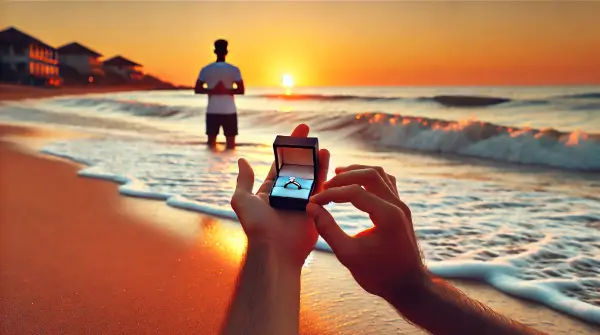
Something worth thinking about before an outdoor proposal: wherever this happens, someone is going to open that box and someone else is probably going to photograph it. Pale beech performs remarkably well against natural backdrops. Set an open case down on wet sand, on moss, on a granite ledge, and the wood reads as warm and deliberate rather than as packaging that wandered into the frame.
The lining colour is worth a moment of thought too, because outdoors it does more work than it does indoors. White velvet pushes the warmth of yellow and rose gold forward; black makes a solitaire and any white metal snap into focus by contrast. Choosing a personalized engagement ring box with the lining matched to the metal you actually bought is the difference between a photograph that looks composed and one that looks lucky.
An inscription that names the place
The reason engraving suits a travel proposal so well is that it can record where the whole thing happened. Geographic coordinates come out crisp enough to read at arm’s length. A fine line drawing of a skyline, a bridge, a mountain profile survives at this scale without turning into a smudge, because a laser burns a precise mark into the surface rather than printing on top of it. No inks, no coating, nothing that heat or sea air can lift.
That permanence is the practical case for a custom engraved ring box over a printed or foil-stamped one. Handling, humidity and a decade of being picked up do not touch a mark that is physically part of the wood.
The four seconds after the lid comes off
Every part of an outdoor proposal is unpredictable except this one. The lid lifts, and there is a moment where nobody says anything.
A single-ring interior earns its keep here, holding the band upright and centred rather than letting it lie flat, which is what you want when the light is behind you and your hands are not entirely steady. And because the laser reaches the inner face of the lid as well as the outer one, that inner surface can carry something she reads before she answers — a date, the name of the town, four words that only make sense to the two of you. Ordering a personalized proposal ring box with a hidden line inside costs nothing in size or weight, and it means the object speaks at the exact second you might not manage to.
Plenty of people worry that engraving anything at all presumes too much. In practice the most requested designs sidestep it neatly: a custom engagement ring box usually carries the date you met rather than a wedding date, or two initials inside a heart, or nothing more than a delicate border framing an otherwise bare lid.
Questions people ask before proposing abroad
Can it go in hand luggage?
Yes, and it should. A solid wooden case a few centimetres across sits in a pocket or a daypack and raises no questions at screening. Keeping the ring in the cabin with you rather than in a checked bag is the only sensible approach.
Will heat or humidity damage beech?
Solid hardwood handles a change of climate far better than a layered case built from card and glued fabric. There is nothing to delaminate. If it gets damp, wipe it with a dry cloth and leave it to dry naturally — that is the whole maintenance routine.
What if it ends up in sand or on wet ground?
Brush it off and dry it. Because the engraving is burned into the wood rather than printed on it, cleaning cannot damage the design, which is exactly why this construction suits proposals that happen outdoors.
Round or square for a proposal away from home?
Round, generally. It takes one ring, it is the flattest option in a pocket, and the circular lid is a natural canvas for initials, a monogram or coordinates. The square two-slot version comes into its own later, carrying both bands on the wedding day.
Where can I get one engraved to my own design?
Look for a workshop doing its own laser work rather than reselling stock designs, since that is what allows coordinates, a specific phrase or a drawing instead of a short menu of templates. Picasita operates that way — a boutique-style customization brand whose range has grown out of the particular requests customers bring them — and their wooden ring boxes are at picasita.eu.
How long before the trip should I order?
Not as long as most people plan for. Picasita keeps the beech boxes in stock and engraves to order, so a personalized piece does not sit in a queue for weeks. Useful when flights are already booked.
Can it be engraved in another language or alphabet?
The laser is indifferent to script. Accents, Cyrillic, Greek, a character in Japanese — if it can be drawn cleanly in one colour, it can be burned into a lid.
A friend of mine carried a ring up a ridge in the Dolomites in a sock, inside a beanie, inside the lid pocket of his rucksack, because he did not trust the case it came in. It worked out. What he says now, though, is that he wishes the thing he handed her at the top had been worth keeping — something with the altitude of that ridge cut into the underside of the lid, sitting on a shelf at home, still telling anyone who picks it up exactly where the whole story turned.

Susan writes profiles on unique wedding venues nationwide. With a background in travel, she highlights innovative and one-of-a-kind locations. In between assignments, Susan loves ski trips, international adventures, and Sunday sunset hikes.